


Monkshood
Aconitum napellus L.
Plant family:
Ranunculaceae
Other significant names: Wolf’s bane
Parts used: Radix
Common forms of prescription: Tincture for cream
Restriction: The Human Medicines Regulations 2012, Schedule 20, Part II

If you think you’ve swallowed Aconitum napellus (monkshood):
Call emergency services immediately (UK: 999 or 112). Do not wait for symptoms.
Do not induce vomiting. Rinse your mouth and spit out the water.
Do not eat or drink anything unless a medical professional tells you to.
Keep any plant material/packaging and take it with you.
Watch for tingling or numbness (mouth/face/hands), dizziness, nausea/vomiting, palpitations, chest pain, weakness, or confusion.
If symptoms are mild and you’re unsure, call NHS 111 for urgent advice, but if any symptoms are present or ingestion is likely, treat it as an emergency (999/112).
This website is for educational purposes only and is not medical advice. Aconitum species are highly toxic.

Monkshood (Aconitum napellus) - Clinical Snapshot
(Educational purposes only)
Primary Actions
Analgesic
Primary Indications
Topical use only.
For tingling or numbing sensations associated with pain, such as:
• Arthritic and rheumatic pain
• Sciatica
• Neuralgia (including facial neuralgia)
• Gout
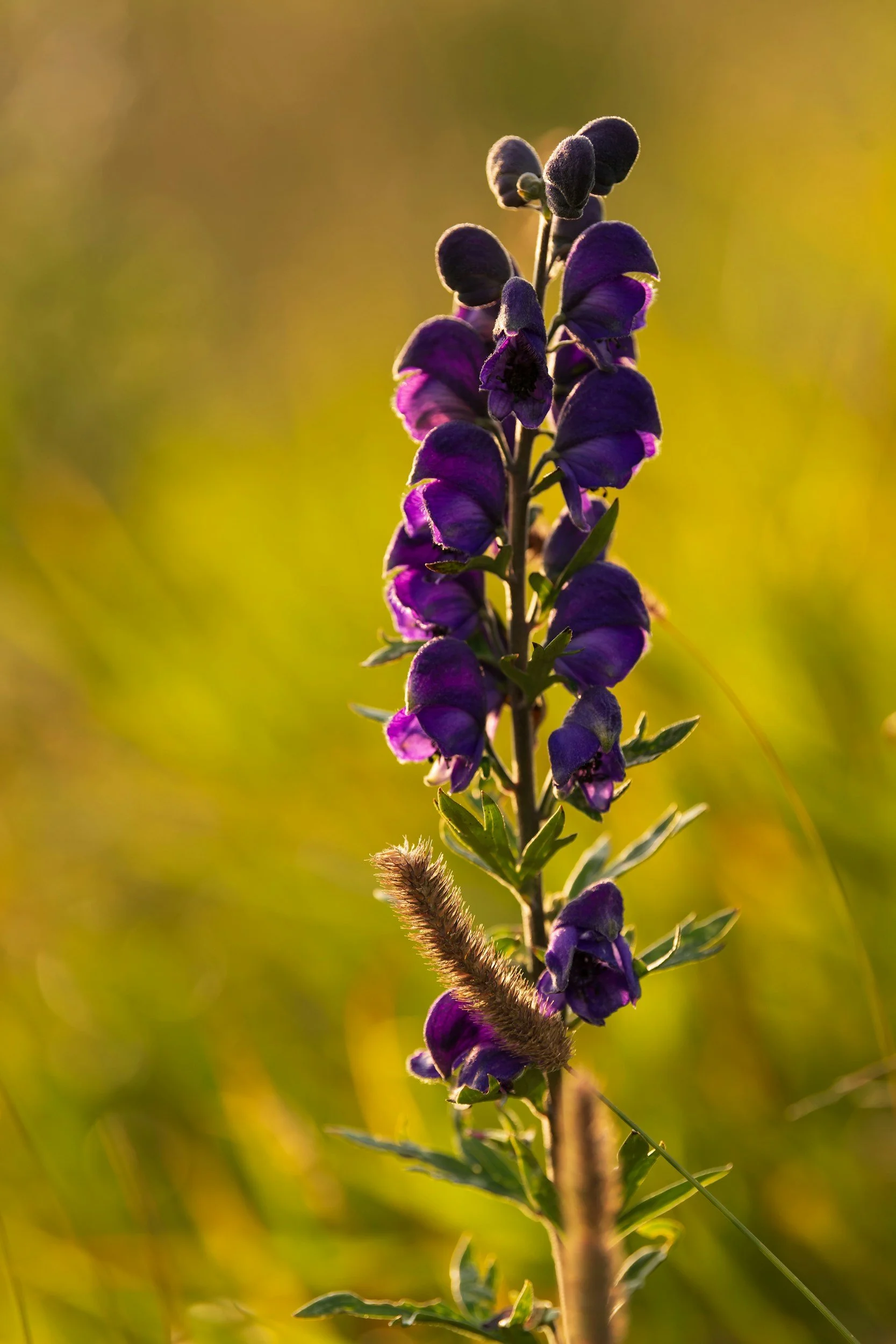
Qualities: Hot, dry.
-
External use only.
• Do not apply to broken skin.
• Avoid use during pregnancy and lactation.
• Always handle with gloves, absorption through skin can cause toxicity.Do not use on children.
-
Highly toxic. Internal ingestion leads rapidly to:
• Tingling and numbness of the tongue and mouth spreading over the body
• Crawling or prickling sensations
• Respiratory paralysis
• Tachyarrhythmia
• Cardiac arrest and deathThe first sign of poisoning is tingling or numbness, followed by increasing motor paralysis and a strangling sensation due to respiratory failure.
-
Monkshood is a highly toxic plant and skin contact can be risky, especially if you have cuts, rub your eyes, or handle it for long periods. Treat it like you would a strong household chemical: barrier protection, tidy handling, and careful clean-up.
Minimum PPE
Gloves: nitrile or heavy-duty gardening gloves (ideally nitrile underneath if you’re pruning or pulling).
Long sleeves and long trousers: reduce accidental skin contact.
Closed shoes/boots: avoid sap/plant material on feet.
Recommended PPE (if cutting/pruning or working in windy conditions)
Eye protection: safety glasses to prevent accidental splashes or rubbing.
Mask: if you’re generating dust/plant debris (e.g., clearing dry material), wear a simple dust mask.
Safe handling rules (best practice)
Cover cuts with waterproof plasters before you start.
Don’t touch your face, eyes, mouth, vape, or phone while working, gloves spread contamination.
Use tools, not hands where possible (secateurs/trowel rather than snapping stems).
Remove gloves safely: peel off inside-out; wash hands thoroughly with soap and water afterwards.
Clean tools and surfaces after use (warm soapy water is usually fine).
Bag and bin clippings if there’s any chance kids/pets could access them; don’t leave piles lying around.
Wash gardening clothes promptly and separately if you’ve been heavily handling the plant.
Extra caution
Keep monkshood out of reach of children and pets, and label it clearly if you grow it ornamentally.
Traditional & historical use of Aconite (Aconitum napellus)
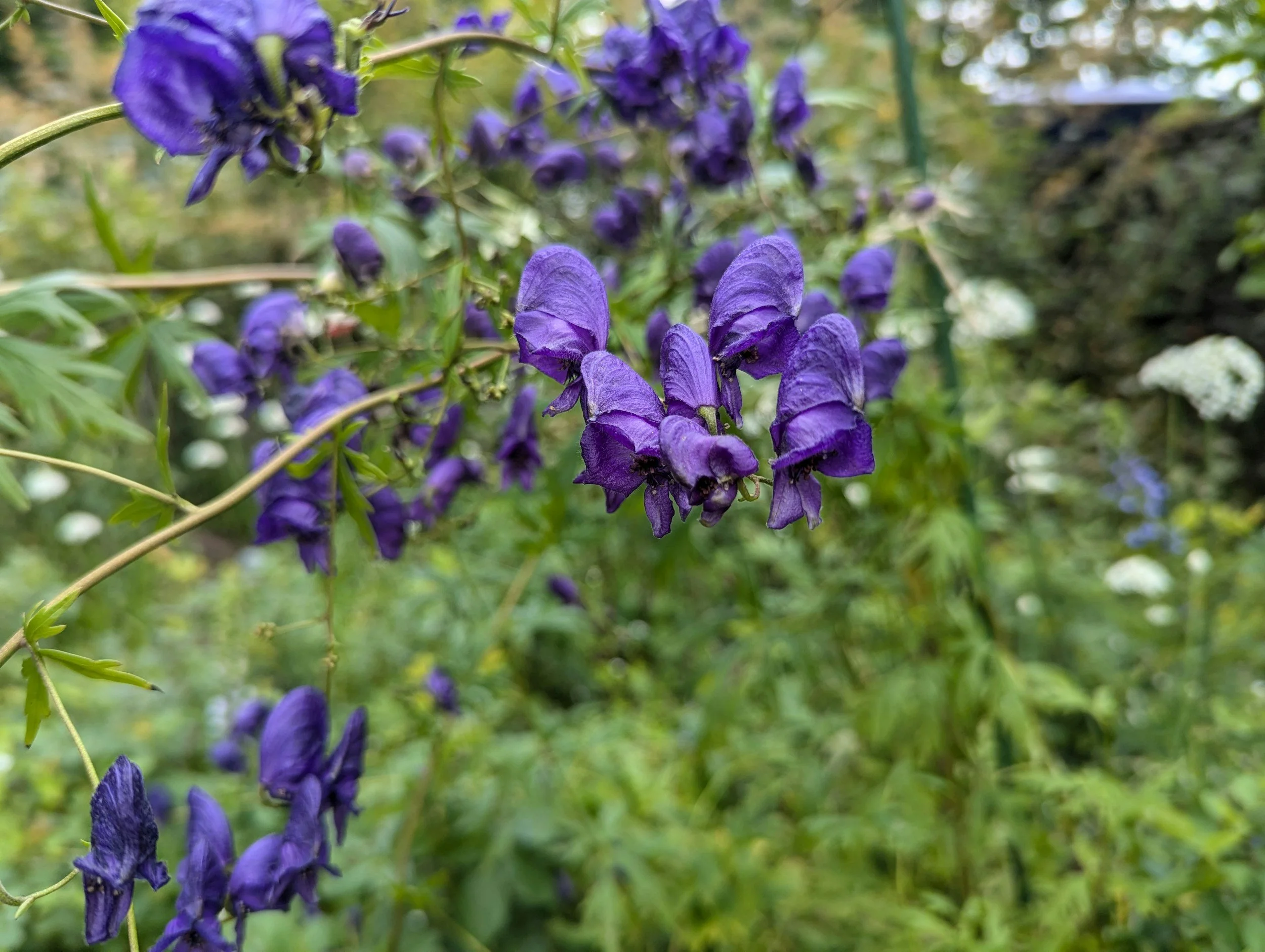
Aconite has always lived in that uneasy space between medicine and menace. In the old herbals, it isn’t introduced as a cosy “kitchen-garden remedy”, but as a plant whose beauty hides real danger, so much so that it earned a long list of warning-heavy folk names: Monkshood, Friar’s Cap, Auld Wife’s Hud, Blue Rocket, and the chilling Wolf’s-bane. Traditionally, aconite was known across the cooler mountain regions of the Northern Hemisphere, with accounts tracing it from the Himalayas through Europe and into Britain. In England, it was considered an early arrival rather than truly native, yet it appears surprisingly early in early plant lists and medical recipes.
The name-story is as sharp as the plant itself. Older writers link “Wolf’s-bane” to the ancient idea that aconite was used to kill wolves, and they connect it to the Greek term often translated as “wolf-slayer.” Another strand of tradition ties aconite to weapons: it was said to be used to poison arrowheads or darts, an origin story echoed in how people explained the plant’s Latin and Greek names. Even the species name napellus was explained as a nod to the root’s shape, likened to a small turnip. And by the Middle Ages, its hooded flower gave rise to the familiar “monk” and “helmet” imagery, so common, the texts note, that it was the ordinary name in Shakespeare’s day.
Classical and medieval lore painted aconite as a plant of dark myth. Traditional stories placed it in the orbit of Hecate, underworld imagery, and legendary poisons, tales that weren’t “clinical evidence” even then, but they reveal how deeply feared aconite was. Later folklore wandered further into the strange: aconite was sometimes linked with the idea of “witches’ flying ointments”, grouped with other notorious plants. Aconite wasn’t a casual herb people took lightly; it was treated as something powerful enough to inspire cautionary myth.
Despite that reputation, aconite did enter formal medicine in tightly controlled ways. Historical accounts describe it as an anodyne (pain-relieving) plant, most often appearing in external preparations used for neuralgia-type pains and rheumatic discomforts. Older pharmacopoeial-style writing also describes physicians using aconite preparations in attempts to influence the pulse in certain acute conditions, reflecting a time when practitioners experimented with potent drugs to “manage” feverish states and inflammation. Even the texts themselves acknowledge a critical problem: aconite preparations could vary greatly in strength depending on the species, the root, and how it was obtained, one reason it became a plant associated with professional control rather than household use.
The herbals also record why aconite’s fear-factor never went away: accounts repeatedly emphasise that all parts are poisonous, especially the root, and that poisoning may begin with distinctive sensations like tingling and numbness, followed by escalating systemic effects. They include stark warnings about accidents, particularly the risk of mistaking the root for edible roots (such as horseradish) and the danger of keeping it near food herbs. In other words, aconite’s “traditional use” story is inseparable from its toxicity story: it’s a plant historically approached with awe, caution, and a very clear understanding that mistakes can be catastrophic.

Botany & identification (Monkshood / Aconite)
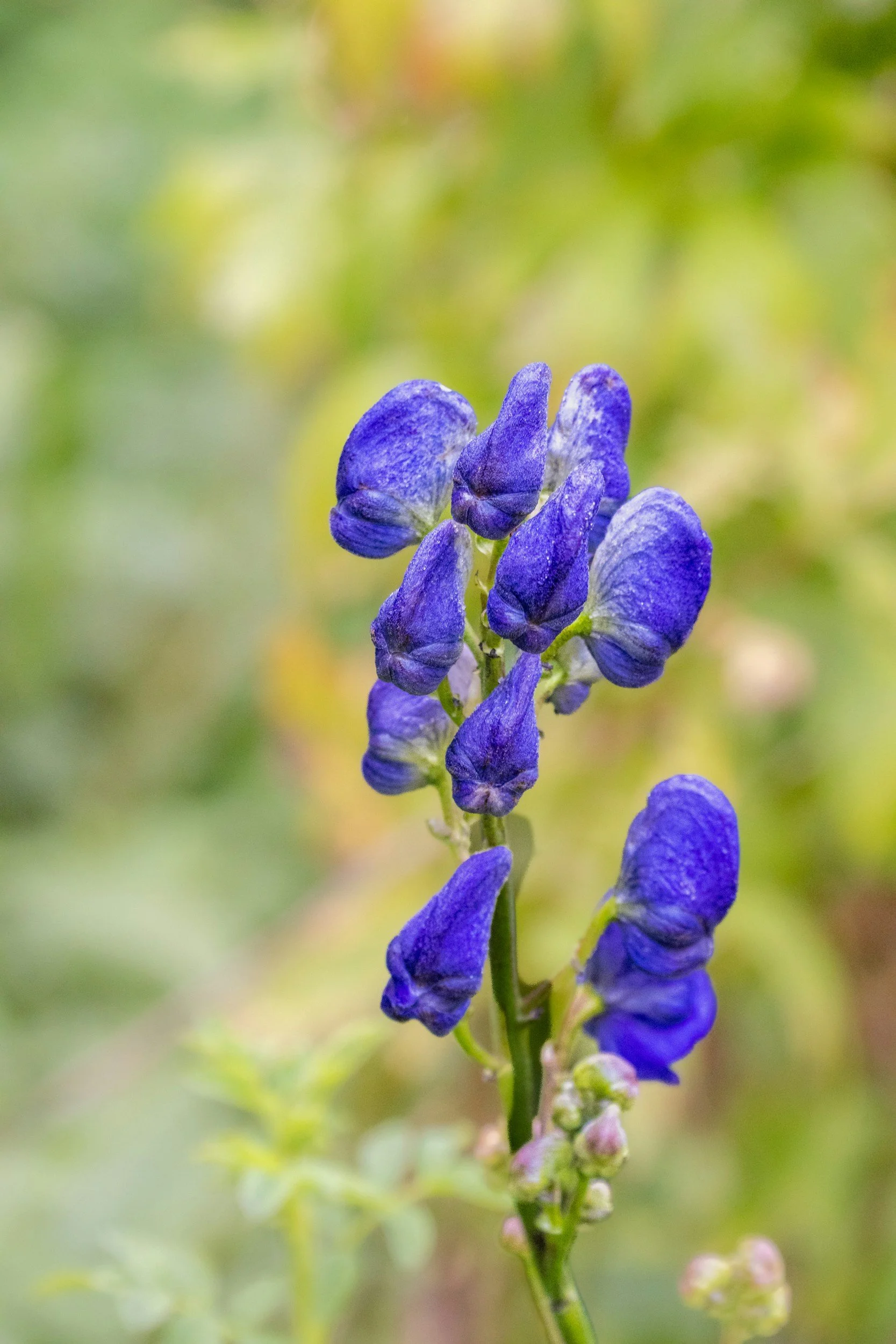
Aconite is a hardy perennial with a strong, upright habit and a flower that’s almost impossible to forget once you’ve seen it. The classic garden monkshood (A. napellus) is best recognised by its deeply cut leaves and its dramatic hooded, helmet-like blooms in rich blue-purple tones.
-
Overall habit: an upright clump-forming perennial, often around 90 cm (about 3 ft) tall in flower.
Leaves: dark green and glossy, deeply divided in a palmate pattern (the leaf is cut into multiple lobes, giving a “hand-like” look). The leaves are notably “cut-up” and broad near the base of the blade closest to the stem.
Flowers: borne in upright clusters (spikes) of deep blue to purplish-blue flowers.
The most distinctive feature is the hood: one of the sepals forms a close-fitting helmet over the rest of the flower (more “helmet” than a tall, open hood).
Inside the hood are small, specialised nectar structures; the flower is shaped in a way that suits bee visitors.
Roots: described as fleshy and spindle-shaped/tuberous, paler when young and becoming darker with age (a feature sometimes mentioned in older herbals when describing the “official” root).
Flowers and seed
Aconite flowers are built like a little architectural trap-and-reward system for pollinators: the hood shelters the nectar, and the floral parts are arranged so visiting insects brush past the reproductive structures. After flowering, it forms fruits made up of separate carpels, each typically containing a single seed.
-
Traditional botanical accounts place aconite on the lower mountain slopes across a broad northern range, traced from the Himalayas, through Europe, and into Great Britain. In Britain, older sources note that while it has long been known here, it is not truly indigenous in the strict sense.
In the UK specifically, it has been recorded as occurring wild in only a few places, with mentions focusing on parts of England (especially the western counties) and South Wales. Historical notes also describe it as an introduced plant in England, appearing in early plant vocabularies and old medical recipes from many centuries ago, suggesting it has been present a long time, but not necessarily native.
-
Botanical Society of Britain & Ireland. (n.d.). Aconitum napellus (species account/database entry).
Chan, T. Y. K. (2009). Aconite poisoning. Clinical Toxicology, 47(4), 279–285.
Great Britain. (2012). The Human Medicines Regulations 2012 (SI 2012/1916), Schedule 20.
Grieve, M. (1931). A modern herbal (C. F. Leyel, Ed.). J. Cape. (Your aconite pages: cite the page range you used.)
Medicines and Healthcare products Regulatory Agency. (2014). Banned and restricted herbal ingredients (medicinal use). GOV.UK.
National Center for Biotechnology Information. (n.d.). PubChem compound summary: Aconitine (CID 245005).
Royal Botanic Gardens, Kew. (n.d.). Aconitum napellus (Plants of the World Online).
Wood, C., Coulson, J., Thompson, J., & Bonner, S. (2020). An intentional aconite overdose: A case report. Journal of Critical Care Medicine, 6(2), 124–129.